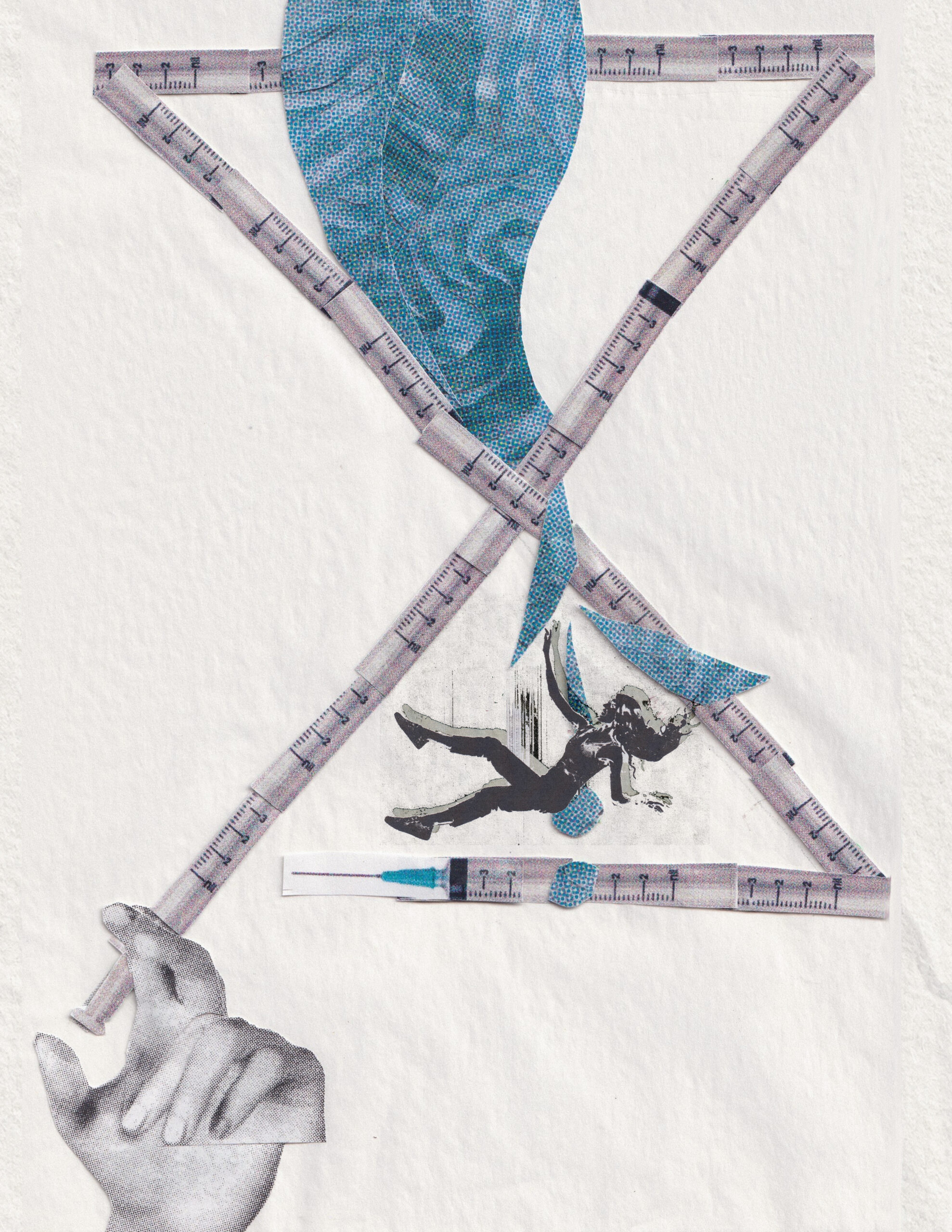
Buying Time
Brooklyn women freezing their eggs are really buying time.
Brooklyn women are spending thousands to freeze their eggs.
What they’re really buying is time.
Y ou might not know it , but your la wyer is freezing her eggs.
So are your therapist and your nutritionist. Your congress woman froze her eggs just the other month. And, this past February, during the coldest stretch of days New York City has seen in over a decade, so did I.
During those two weeks, I looked inside myself…literally.
I saw parts of my body I’d never even pictured, though they’d shaped my months, defined my dreams, and fed my anxieties.
(“This one’s your right ovary,” a kindly tech explained to me during my first early morning in the stirrups. Believe me, with an ultrasound wand buried deep inside of me—I knew it was my right ovary.)
That winter, I walked for miles, one time trekking from my monitoring appointment in the East 50s to my home in South Brooklyn on foot. I heaved myself over slush puddles and exhaust-besmirched snow mountains, my center of grav ity more distended by the day. I bought too many sweatpants.
I injected myself repeatedly, thankful, just this once, for my squishy tummy. I hit a capillary, blooming an indigo bruise the size of a silver dollar. I drank too much Liquid IV . I discovered that ice can burn. I wore a royal purple surgical gown.. I peed so, so much.
I did it because I wanted to, and I could. Because I thought I needed to, orI was afraid of what would happen if I didn’t.
Because I plan for the worst and hope for the best. Because I knew that tens of thousands of twenty- and thirty-somethings like me are making the same choice, for just the same reasons, andI didn’t want to be left behind.
[nut graf (or 2) here.] If she meets the love of her life tomorrow, Chelsea figures, they will need at least two years before having children. In two years, she’ll be thirty-eight. Doable. But, this is New York City, and counting on Mr. Right to notice her across a crowded subway car anytime soon feels awfully optimistic. Sometimes, as her friends , get engaged ,get married, and get pregnant, Chelsea wonders if she might choose to become a single mother.
But even entertaining the possibilityfeels like giving up. And Chelsea’s not the type for that.
To Chelsea, motherhood is an unequivocal good in a bru tal world. She spent years at a Brooklyn nonprofit defending immigrants in court, and she’s seen [can you be specific about what is cruel and callous?]. But, when asked why she’d want to bring a baby into this mess, her inner idealist emerges. A child, raised by Chelsea and a future unknown partner, might help make that change. They might become an advocate or activist.
They might bring about the brighter and more just future that Chelsea works for every day.
Nothing less than the fate of humanity : those are the stakes every time Chelsea goes on a first date. But it can be like that, when one’s chance at parenthood is on the line. Even worse than the wanting is the waiting, and the sensation of time slipping away. For thousands of women waiting for the circumstances of their lives to cooperate, it can feel like there is nothing you can do to attain the thing you desire most.
That’s what makes egg freezing so enticing. It’s a way to freeze time. he procedure known as oocyte cryopreservation began, in the 1990s, as a strategy to preserve fertility for people undergoing cancer treatments. The basic Tidea is to artificially mature a large number of eggs in a person’s ovaries, surgically remove them and suspend them in a tank of liquid nitrogen at -320℉ for years, even decades. At any time, the eggs can be thawed, fertilized, and returned to the body as embryos.
In 2012, egg freezing received the designation of “non-exper imental” from the American Society for Reproductive Medicine and the Society for Assisted Reproductive Technology (SART), allowing the procedure to enter the medical mainstream.” In the ensuing decade and a half, the number of procedures has ballooned. According to SART, 39,000 people chose to freeze their eggs in 2023 (the most recent year for which this number is available). It’s doubtless climbed since then.
39,000 constitutes a small segment of the 67 million Amer icans whom the CDC deems “childbearing.” For segments of New York City, though, it doesn’t feel that way. In Downtown Brooklyn between 6 and 9am, the Reproductive Medicine Asso ciates waiting room fills with fresh blowouts, gel manicures, and soothing neutrals as young professionals await their blood tests and transvaginal ultrasounds. Similar scenes play out at Columbia’s fertility center near Columbus Circle, Cornell Weill’s on the Upper East Side, the boutique clinics that dot the city from the Upper West Side to Astoria, and my own tastefully appointed waiting room of choice, NYU Langone.
[Can you add a small section here about the rise in fertility clinics across NYC, and otherwise ground this story in New York. You can also talk about how certain clinics advertise to patients, and maybe (if it fits) something about the trendifi cation of the procedure in New York circles. This also segues naturally into your next paragraph about demographics.] It’s little wonder New York City is a hotspot, given the demo graphics at play: healthy people who freeze their eggs generally range from mid-twenties to early-forties. Anecdotally, they are often proactive, information-rich, and professionally driven.
Practically, they either have great insurance, or the means to pay (more on that later). These are the children of No Child Left Behind who were never at any risk of being Left Behind—the gifted kids dubbed heirs to the Information Age, the ones who came of age in a world seemingly determined to obliterate itself.
On egg freezing subreddits, Facebook groups, WhatsApp chats, and Discord channels people swap stories, affirmations, and sometimes medications. I personally have so many egg-freez ing-veteran loved ones that, during my fourteen days of freezing, I often hosted impromptu parties in my Kensington living room while prepping nightly injections. (When it turned out I could administer my final “trigger” injection to my abdomen instead of, as is often done, in my rear end, my egg-freezing groupchat reacted with some disappointment. A friend complained: “But I wanted to inject your ass!”)
Meanwhile, the average age of an egg-freezing patient con tinues to fall, as more young people in their twenties and early thirties opt into a procedure once viewed as a last resort.
Bridget, a Manhattan-based creative, remembers the day she found out that she had the ovarian reserve of a woman in her mid-forties. She’d walked into the clinic at thirty-three, confident, buoyed by a family history free of fertility concerns.
Three years and four clinics later, she has diagnoses of silent endometriosis and premature ovarian failure. “I was destroyed,”
Bridget recalls. “It was the biggest bombshell of my life.”
For many people handed this kind of news, there is little option but to take action. Determination hardens into resolve, which ossifies into certainty: as hard as this process may feel right now, not trying will prove even worse. People undergoing egg freezing often speak of a “future self,” the one who’s finally ready to have kids, who will look back at their twenty-six, or thirty-four, or forty-two-year-old choices and ask, “Why didn’t you try harder?” In this logic chain, the worst thing that might happen is not present pain, but future regret.
Such a belief can override any doubts a person harbors about “This one’s your right ovary,” a kindly tech explained to me during my first early morning in the stirrups. Believe me, with an ultrasound wand one day becoming a birthing parent, as the tangible solution before them eclipses the implications and complications of a distant, possible outcome. Bridget, despite years of fertility treatments, still does not know whether she will choose to become a mother. She wants to keep being an artist, to embrace a life of freedom and adventure. At the same time, she yearns to forge the kind of maternal bonds she experienced with her own mom and grandma. Within this conflict, Bridget describes her diagnoses as clarifying: the grief she felt over potential infertility overwhelmed her ambivalence, at least for a time. There’s an “intensity of want,” she reasons, that must be driving her, even if it doesn’t always enter conscious thought. Otherwise, why do this at all? here’s another question that hangs over every fertili ty-preservation story, perhaps not as important as “Do Tyou want to be a parent?” but certainly of more material urgency: “How are you affording this?”
For Bobbin Ramsey, it took totalling her car.
A theater director whose favorite shirt reads “ABORTION IS FOR EVERYONE” in the “I LOVE NEW YORK” font, Bobbin believes in reproductive freedom, and in honoring the myriad ways that a person can contribute to the world. For her per sonally, that contribution involves having a child. (“I’ve had these breasts for thirty-six years,” she explained, musing about pregnancy, “and you’re telling me that milk could come out of them?!”) In 2024, having separated from her partner of ten years while in graduate school, Bobbin had begun to consider the possibility of egg freezing. After an accident left her orange MINI Cooper wrecked on the side of the road, Bobbin started thinking of seven years of car payments as an investment of a very different sort. When she got her insurance payout, she immediately earmarked the funds for fertility preservation.
After all, Bobbin reasoned, she was about to start a directing career in New York; who needs a car?
This kind of calculation is not uncommon for people consid ering fertility preservation. Except in certain medical situations, such as commencing chemotherapy, most insurance policies consider egg freezing elective. Depending on the clinic, patients can easily spend between $7,000 and $15,000 out of pocket on buried deep inside of me, I knew it was my right ovary. the procedure. The injectable drugs alone (nicknamed “stims” because they stimulate egg growth) can run up to $5,000. If freezing embryos, which requires additional tests and proce dures—but provides the most certainty about future outcomes— the cost skyrockets further. Faced with this level of financial burden, egg-freezing candidates will often run up credit cards or borrow from family members. Some will qualify for grants from organizations like B’nai Olam, while others will take out a Future Family Fertility Loan (which is exactly what it sounds like). A minuscule number of employer-provided plans cover elective fertility preservation, and while this option is spreading bit by bit, it comes with drawbacks. People stay at jobs they don’t like, or seek out new positions they don’t necessarily want, for fertility benefits. Those in their twenties with this kind of expansive coverage often feel pressured to freeze earlier, worried that later on, they’ll have to pay exponentially more.
It’s easy to look at the fertility field and see a cynical cash grab, an industry designed to leech off the desperation of people who want babies. Talking to someone like Susan Crockin reveals a more nuanced perspective. A pioneer in fertility law, Susan has been watching this field evolve, and helping shape it, since 1988.
Though grateful for the increased awareness of the past decade, Susan feels wary about the expansion in egg freezing, especially when it comes to predatory advertising. (“Do you remember the 90s?” reads a recent Gaia Fertility ad, graced with an incongru ous yellow Tamagotchi. “You might want to freeze your eggs.”)
She believes that the industry is eager to “entice” people who may not need to freeze their eggs into doing so anyway, all to pad their bottom line. As evidence, she points to the promise of one cycle that might turn into two or three or four. She cites the cumulative cost of a twenty-five-year-old freezing their eggs, keeping them on ice for a decade, and paying $1500 a year for the privilege of doing so. At the same time, Susan, herself a beneficiary of IVF, believes passionately in people’s right to control their reproductive futures. So, yes, every year she tells her twenty-something law students not to freeze their eggs…yet.
But, when she recounts how they never listen to her, she seems a little proud of their independence and their drive.
For Bobbin, freezing cost her a car. For Chelsea, the immi gration lawyer, it took years of saving her nonprofit salary.
Bridget—whose fertility treatments stretched on and became increasingly complex—scrounged for grants, bartered with clin ics, and swapped stims with others she’d met online (note: this is technically illegal, which is why Bridget isn’t her real name).
Were these choices, made in the present but for the future, justi fied? Well, that’s one of the agonizing things about freezing time: only some nebulous, imagined self can say how it’ll all turn out. he stims don’t hurt…mostly. A drug called Menopur can sting. Another, named Gonal-F, can feel like nothing at Tall. An antagonist drug called cetrotide, administered to avoid premature ovulation, may leave a rash. The intramuscular injection is gnarly, I hear. But for Veronica Lee, a Broadway stage manager whose most recent show involved covering Nicole Scherzinger with blood eight times a week, the needles were less of a shock than the vials.
I met Veronica in her [description].Gesturing at a box of medications on her kitchen island (we originally spoke on Day 6 of her egg-freezing protocol), she exclaimed, “It’s like one big science experiment happening over here…I can’t believe we’re allowed to do this to ourselves!”
Here’s what Veronica meant: some medications, like Gonal-F, come in a pen to be stabbed in the stomach. Calibrating their dosage is as easy as turning a dial. Others, like Menopur, come in vials that need to be titrated according to prescribed doses.
One vial may turn to two, or even three, depending on how the body responds. Given the price of the medications, and the precision of the protocol, making a mistake can have substantial consequences. Still, egg freezing, despite its constant monitor ing, futuristic wands and cryogenic gases, , can feel a little DIY.
With a sharps container on the counter, vials in the fridge, and syringes next to the wine glasses, it can be hard to shake the feeling that surely an adult should be supervising.
Freezing upends routine. Or, rather, it begets a new routine, one of hormone-related insomnia, semi-daily trips to a morning monitoring clinic for transvaginal ultrasounds and blood tests, boxes and boxes of disinfecting wipes and ice packs, brimming sharps containers, and needles. Always more needles. Some peo ple, like the level-headed, methodical Veronica, arrange their whole year around when they plan to freeze. Some, like Bridget and Bobbin, freeze while in grad school, gamely discussing nar rative structure and theory between hormone doses.
Internally, egg freezing upends an entirely different routine.
Ordinarily, only one egg matures in the ovaries at a time, burst ing its follicle before heading down through the fallopian tubes to be, potentially, fertilized. The stimulation protocol developed in the 90s and honed in the 2000s, however, can yield dozens of mature eggs at once. Ultrasounds track the maturation;.blood tests assess how the body is reacting to this flood of hormones; doctors read the charts anddetermine what kind of stims a person uses, how many, and for how long.
For some, this internal change feels miraculous. When Brooklyn-based arts administrator Chloe Knight froze her eggs at twenty-six, she found the whole thing spiritual. “It always felt personal,” she recalls now, four years later. “It was always deep.” After appointments, she’d head to a nearby beach and look out at the water, thinking about the world around her, and the worlds she was growing within. Others take a less-encom passing view. One young woman I spoke to described herself as a “chicken growing eggs.” Another, talking about the morning monitoring, said she felt like a patty in a Burger King kitchen [—-]. . Chelsea, who had an immigration case blowing up and a cat with an eye infection throughout the period of her egg freezing, had no time to think about what was happening to warps, like gravity around a black hole. And then, suddenly, the waiting stops. k, I am going to be very annoying and go back on my suggestion from the last round. Given how the rest of the Opiece reads, I think you should actually bring yourself back here! I’d love a first person account, similar to your open ing, of how the egg retrieval process went for you, to bring the reader into the experience. You had this in your last draft, and I think you can use much of the same language if you like it, though ideally with just a touch more straightforward sensory observation/detail. I know I’ve been banging the drum for less Gabrielle, but we’re due for some scene writing right about now, and you’ve done such a good job telling the story through char acters that we actually do want a bit of your story here. A scene of you describing the sights, sounds, smells and feelings of this process before then (briefly) exploring those same experiences through your characters would be really powerful.] Bobbin has positive memories of her first egg retrieval.
The doctors were patient, the nurses kind. Afterwards, they let her stay as long as she wanted to recover from the propofol, fentanyl, and midazolam she’d received intravenously while medical staff removed eggs from her ovaries by inserting an ultrasound-guided needle through her vaginal wall. Others aren’t so lucky. People sometimes report an “assembly line” her., “I was just stabbing myself every day and hoping for the best,” she says.
There’s a feverdream quality to these two weeks of injections. Though long, exhausting, and pointy, the days have a syrupy quality to them, a sense of waiting without end. Maybe that’s because, paradoxically, in getting ready to freeze, one must first speed time up. Externally, a person might be resting, working, injecting, But internally, the body is workingin hyperdrive, as eggs—two, three, twelve, sixteen, thirty-seven—begin to mature and swell the ovaries. The cycle of menstruation whose regu larity, or irregularity, or presence, or absence, metronomizes approx imately half the population’s lives, abruptly ruptures. Tissue stretches.
Organs balloon. Fluid builds. What happens, in these weeks, could never happen in nature and, without stims, will never happen again. The the nat ural rhythm of the e body, established by the regular secretion and metab olism of foundational hormones — feel during retrievals. Clinics also tend to stack retrievals one after another, meaning that as soon as one patient leaves a bed, another takes their place (burger patty, meet bun).
Not every patient knows, as the process unfolds, whether it is going well or poorly. No one told Bobbin that her ovaries had not responded as hoped to the stims with which she had injected herself. No one pointed out the few follicles visibly growing on her ultrasounds, just as no one ever explained the low numbers found in her bloodwork. Chelsea, on the other hand, was told many times by her doctors that she was respond ing well. Others recall doctors dropping cryptic clues and using phrases like “setting expectations” well before they hit retrieval day. Some clinics even advise patients to plan for a second round before they’ve finished their first. One woman, who’d undergone the process twice, and tapped into her retirement savings to do so, referred to her first round of egg freezing as a “dummy round,” explaining that her medical team had needed time to calibrate her hormone doses to her specific body chemistry.
(But, she complained, rightly, she wished it hadn’t cost so damn much.)
As far as I can tell, these differences in transparency can’t be broken down by clinic, or even by doctor. They depend, often, on the choices made by an individual ultrasound technician or nurse. The impact that communication can have on the overall experience, though, is striking. When a person feels informed about what’s going on internally, they maintain more positive feelings about the process as a whole, even if the number of eggs retrieved falls short of their hoped-for outcome. The reverse, like what Bobbin experienced, often leads to feelings of shame and anger that go deeper than a single round of egg retrieval. People have told me they often wonder why they didn’t know what was happening inside of them, or castigate themselves for not having spoken up. Where there was hope for the future, there sometimes materializes contempt for a past self: the cockeyed optimist who didn’t know what they were getting themselves into, and who was too stupid to ask.
And then, after weeks of pricks, pokes, insertions, cuffs, wands, and needles, thousands of dollars and raging self-doubt, it all ends, abruptly. Absent complications, a person never has a follow-up visit. If they don’t plan on another round, they may never enter their fertility clinic again. What they’re left with is a sore abdomen and a final number, which becomes the measure of whether it was all worth it. obbin was told she had produced three mature eggs. It was a disappointing outcome. [Can you fill in here how Bshe felt? Did she feel regret for having gone through with the procedure, despair at the outcome, hardened resolve to try again? You can also explain here what happens next: she decides to go in for a second round, and how that second round goes].
Chloe, who used to take her growing eggs to the beach, remembers that the ticking clock she’d carried around in her head for years quieted after her retrieval. She had, she felt, bought herself time. Others, like Chelsea, never experience that ease. Despite a positive result, she still dwells on the same frus trations in her singledom, and still feels the fate of the future on every disappointing first date. . She looks back on her retrieval, now, with mixed feelings—proud of the bravery she showed, but wishing, still, that she’d never had to do it at all. After their retrievals, neither Bobbin and Bridget found respite from fer tility worries; after all, they both knew that they’d have to do it again. For Bobbin, it took another round at a different clinic… this time aided by her mom and grandma, since she couldn’t exactly crash another car. For Bridget, it’s taken years, so much so that she describes fertility as “my full-time job.”
There is still much uncertainty to come. iI they ever get used, those frozen eggs will need to survive thawing, be successfully fertilized by sperm, commence embryonic devel opment, and possess genetically viable chromosomes. (At each stage, the attrition rate can equal 50%.) Then, those embryos must implant successfully within a uterus, begin to grow, evolve safely for nine-ish months, and eventually, be born. (And then, my mom assures me, the real uncertainty begins.) All this poten tialitylives within those frozen eggs. That’s why, for many, the period of egg freezing proves so indelible: it is two weeks during which one lives in the subjunctive mood,a world of may, could, if.
Still, there is no accounting for the present. Bridget’s proof of that. Having gone through [how many] rounds of freezing and multiple clinics, she determined, along with her doctors, that her surest path to becoming a parent lay through freezing embryos with a sperm donor. The procedure was successful, and, only a few [days/weeks/months?], Bridget a went to a friend’s wedding feeling triumphant. Who needs a man?, Her unfettered attitude must have made an impression; days after the wedding, a fellow guest, having scoured the internet for her contact information, sent her a message. . He said he found her “captivating.” A year later, Chelsea is readying herself for another round of embryo freezing, this time with the sperm of her fellow wedding guest, now her life partner. (Though she still doesn’t know if she wants kids.) Her future, or at least a version of it, is suspended in nitrogen tanks. But she has discovered what those of us who have frozen all will, eventually: we can, miraculously enough, freeze the living tissue that contains our hopes, aspirations, and dreams. But we can never freeze time.