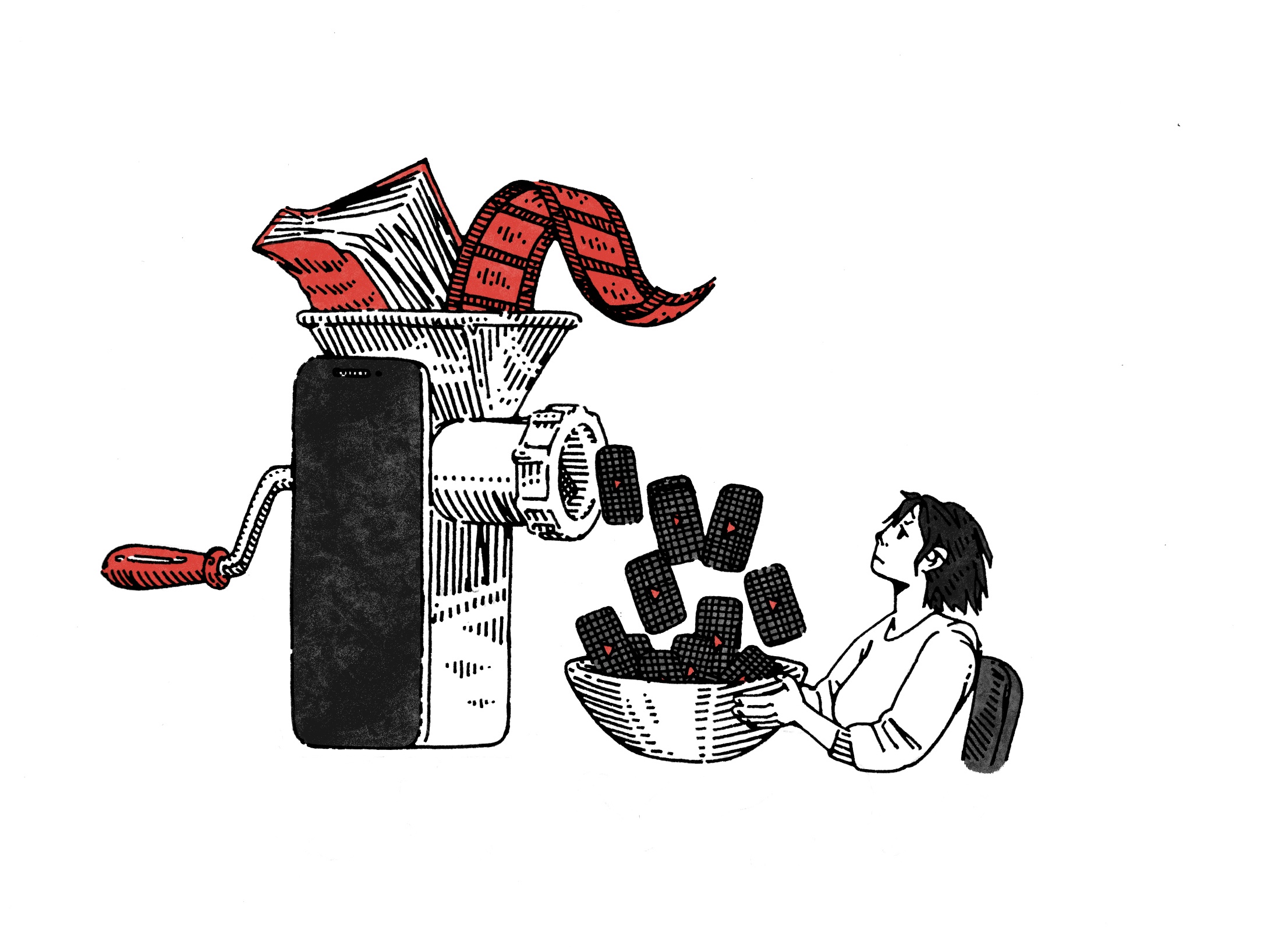
Can I Eat My Feed test?
Surviving the era of TikTok mush.
I teach a class to first-year college students about the current and long-established threats to their education and its use, or value. Like other classrooms across the country, we often circle the same questions: how are we to adapt to a world and a workforce where skills and information exist in such plentiful supply, largely thanks to AI, that there is little market for them, and how do we place value on our own skills and internal sources of knowledge without this external demand? These questions are personal for me. As a writer and journalist in the age of large language models, I grapple with them daily.
The struggle to assign value to human art comes, in part, from the domination of short-form video. Across disciplines and regardless of content, information in all of its forms must be presented in a scrollable, vertically moving image lasting between twenty seconds and two minutes if we are to expect “engagement” (whatever that means). Advertisers or consumers, teachers or students—we all know this. We must boil down our work to images, replicable and repetitive, in hopes of making it on the algorithm, a phrase as broad as the content it contains.
We’re left with information so compressed and flattened that its immediate meaning is often obscured. What was once an opening scene to a movie becomes a spliced one-minute TikTok, and the same goes for a movie review or policy analysis or conversation. Alongside the video-ification of all information comes an increase not just in the number of videos but in the amount of content each one contains. One TikTok, for example, might showcase ten rap verses from different songs or ten scenes of dialogue from different movies. We are inundated with rapid visuals, stacked one atop the other, each commanding our attention before the previous has a chance to register. This kind of modern media diet would be a problem if comprehension or appreciation were the goal.
This phenomenon is one strand of the double helix which, with each passing terabyte, determines our consumption genetics. The other is an imperative that new content—sequels, live-action remakes, biopics—be familiar to viewers. Intellectual property is, it seems, infinitely recyclable because each iteration begets an ever greater opportunity for audience investment, where “investment” is a catch-all phrase for watching, pretending to watch, streaming silently, etc. It echoes an old complaint of artists of all genres: new ideas simply won’t get made. Yet now it is not just about new ideas; it applies to art or content generally. To access a broad audience, the art must kowtow to some preestablished concept that a viewer can latch onto.
On the topic of reproductions in art, Ways of Seeing author John Berger and his co-essayists write: “The uniqueness of the original now lies in it being the original of a reproduction. It is no longer what its image shows that strikes one as unique; its first meaning is no longer to be found in what it says, but in what it is.” Berger was writing about photographs of paintings, but the same idea applies to the original sources of digital fragments, distilled into images and videos that are then reproduced and shared so many times that they beget their own vocabulary, movements, soundtracks. My students and I discuss this when it comes to their digital consumption habits. Their familiarity with contemporary canonical media—The Sopranos, let’s say—is often limited to one character, phrase, or detail. Discrete images from the show circulate within a consumer’s “feed” (a term which suggests sustenance for livestock, pellets shredded and repackaged as foodstuff), and consumers come to see this decontextualized, elided slice of a whole as a new whole itself.
Berger also addresses this function of “the feed” in Ways of Seeing: “The meaning of an image is changed according to what one sees immediately beside it or what comes immediately after it.” To continue with The Sopranos example: an entire season of the show might be chopped and screwed into a two-minute compilation, followed by a thirty-second clip of a well-known scene, followed by memes of the characters. TikTok optimists can manipulate this into a hopeful sentiment. The infinity of your feed can, in your hypnotized scroll, amount to a value greater than the sum of its parts. But we know this isn’t true: half of the point of scrolling on TikTok is to be dazed, severed from the reality of mindful cognition, for the content to be so meaningless that you can watch the same video twice without realizing it. A viewer of the sequence I described might feel pleasure at both the stimulation of an artfully made TV show (we can now call ourselves fans of The Sopranos, even without watching the whole thing) and pleasure at being able to recognize it as such. More than that, you might be able to feel that you better understand The Sopranos from this fragmented, removed context. You can see how good we (or you) had it in the past, when The Sopranos was the thing we watched, and not TikToks of The Sopranos. You can see now how astute the cultural commentary, how thoughtful the set design.
Nostalgia and smugness, though byproducts of reproductions online, are some of the only emotional benefits (if positive feeling can be considered a benefit, given the costs). And because this clip is preceded and followed by similar reproductions, what compounds is not the art or your understanding of it but the pleasure-bursts of discrete moments, brought into relief by virtue of digital, temporal manipulation. For those of us who want to create art, or to learn to appreciate it, it is an existential problem. Audiences may not be interested in, or capable of, identifying meaning in what we make because we are in direct competition for attention with the scrambled pellets of the feed. Artists rely on the reciprocal, tending work of interpretation; without audiences ready or willing to interpret it, the art and its conceptual underpinnings begin to feel like decoration, entertainment—the very stuff relegated to “the feed” itself.
To adapt to this inescapable diet of mush—reproductions embedded within and in sequence to one another—we contemporary artists are compelled to use fragmentation to our advantage. As with the perspectival shifts of the modernists and the cubists, and the formal (or antiformal) shifts of the postmodernists and performance artists, what is senseless or constraining for one generation of artists can be an organizing principle for the next. That is the nature of adaptation: to hold on to the vestiges of advantage and success and to hope that they will tide you over until the next evolution comes.