Who Gets to Call Themselves a New Yorker?
The question alone is just so New York.
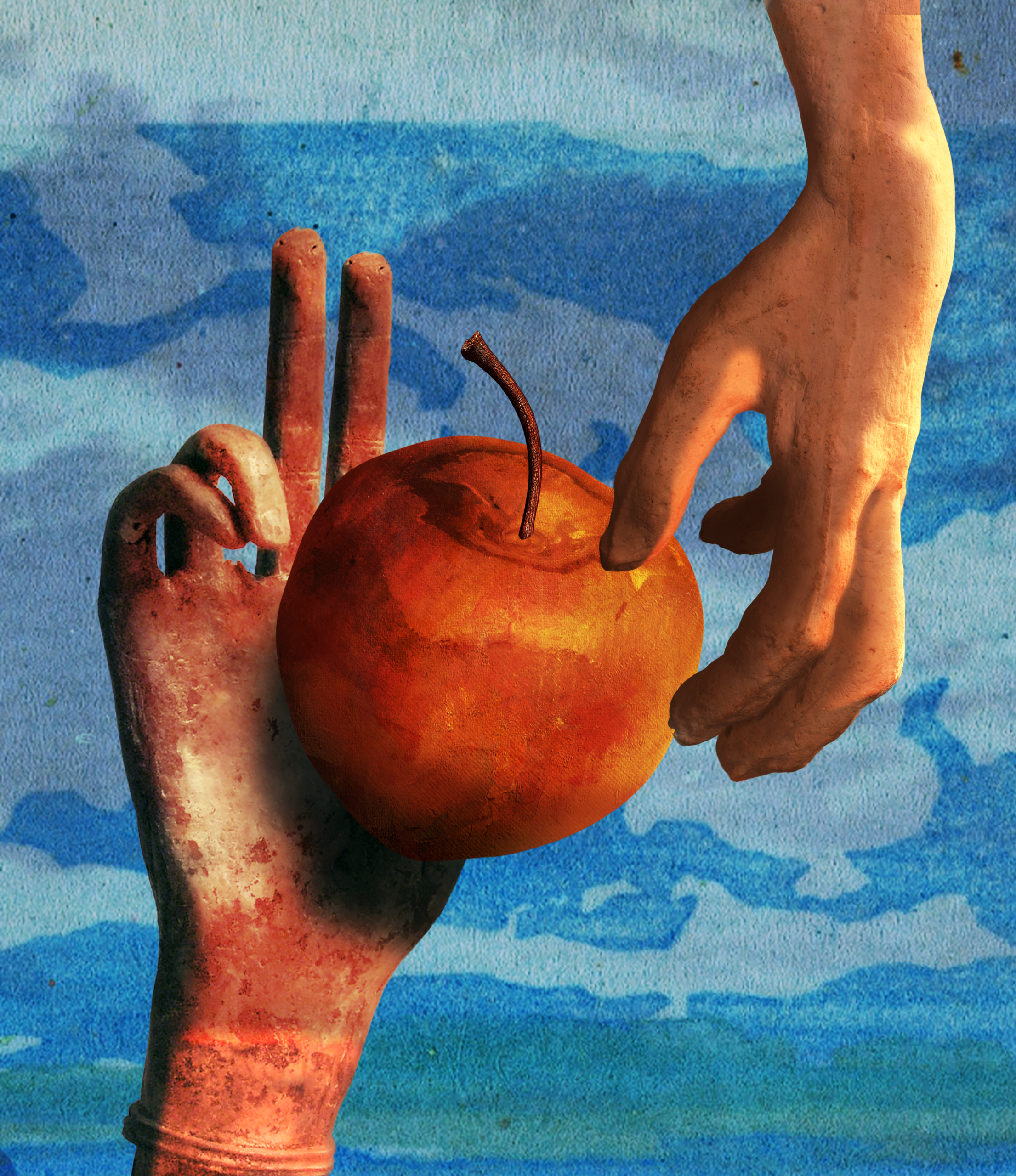
Illustration by Zawar Ahmed
To some, the criteria are loose and inviting: you’re a New Yorker so long as you live here, or work here, or love the city irrationally. Maybe you don’t even have to love New York to be a New Yorker, just prefer it to the repressive/boring/conventional/cleaner and better-smelling place you grew up, and of course you can call yourself a New Yorker because who the hell gets to gatekeep?
Sure, if you’re a recent transplant and want to say you’re a New Yorker because you felt genuine emotion during the last three rounds of the 2026 NBA playoffs (you’re not dyed-in-the-orange-and-blue-wool enough to have lost sleep when we went down two games to one against the Atlanta Hawks—damn you, C.J. McCollum—but whatever), then go ahead, call yourself a New Yorker. Also, a bandwagoner. Who cares? The more the merrier. One thing about this city: size matters.
To some, such openness dilutes what it means to be an official New Yorker. An acquaintance of mine allows for any of three requirements, and only three: you were born here; you’ve lived here a minimum of fifty years; or you live here and sent/are sending one or more children to public school. If any of these are you, then congrats, you can call yourself a New Yorker. If not? Poseur.
Far, far too much of the rest of the world thinks a New Yorker means someone who lives in Manhattan. Those of us who don’t (Queens-raised, thanks very much) actually think you’re more authentic if you grew up in one of the other four boroughs, because Manhattan has way too many carpetbaggers and phonies, never mind entire skyscrapers whose “residents” are absentee oligarchs from Russia, the Middle East, China, and who the hell knows where else. Sorry, Manhattanites: you lose points for inauthenticity-by-suspicion.
Then again, there were those who, for a brief but dark time in New York’s history, wore “718” T-shirts to validate their…what? Bona fides? Outer boroughness? That tweeness only works at a Wes Anderson film festival.
Everyone’s got their disqualifiers. A childhood friend (also from Queens) who went to Stuyvesant High School told me that on his first day, one of the seniors greeted the incoming students with this pronouncement: “We make fun of two groups here: the football team and people from Staten Island.” (And the elite wonder why people can’t stand them.)
Once, at a party in college, a girl asked my roommate where he was from. “New York,” he said.
“He’s not,” I interjected, as if there were legal ramifications. “He’s from Teaneck.”
Do Bronxites get a kicker for being attached to the mainland? Do Brooklynites get a demerit because the place is overrun with transplants and the new rich? Do we of Queens lose points because (a) half of us are practically suburban, and (b) we’re the only borough without an accepted demonym? Queensians? Queens Gambits?
How do we sort all the government workers, cops, firefighters, sanitation workers, Wall Streeters, etc., who work in New York, protect and clean and run our city, but have decamped to Long Island, Westchester, New Jersey, and even Connecticut? Do you lose your credentials if you move for tax reasons? Suppose you’ve always dreamed of an in-ground pool?
I get it. The whole argument can sound silly or, worse, incendiary. A certain strictness about who gets to call themselves a New Yorker appears eerily nativist, redolent of immigrant-facing panic. Identifying with a group can be (almost always is) exclusionary, divine right-ish.
We humans can be so spectacularly binary and unnuanced that identification, including self-identification, is forever an act of hostility, conscious or not. Maybe George W. Bush said it most succinctly a couple months after 9/11: “You’re either with us or you’re against us.” Pick a lane.
We insist on associating. Absent that instinct, college sports don’t exist. Or pro sports. Or corporate brands, the EU, NATO, OPEC, all political parties, and mahjong clubs. Also religions, war, and national boundaries, but that’s getting picky. When I was a kid, my family drove cross-country. We were in the middle of Wyoming and had to refill the car. My father, Brooklyn-born and bred, got out to stretch his legs, light a cigarette, and chat with the old man at the gas station. When he got back in the car, my father said, “He’s a New Yorker. Grew up a few blocks from me.”
But was he, Dad? If you’ve spent the past several decades living among cowhands in the shadows of the Tetons, are you still a Flatbush boy?
For most of my life, I copped to having lots of Russian blood: my mother’s mother and father were both born in the old country. Then, after Vladimir Putin invaded Ukraine and it suddenly mattered that the regions my grandparents came from were technically Ukrainian, I switched to saying I had lots of Ukrainian blood. We have to declare we’re something. We’d like to take pride in it; feeling superior is even better.
We’ll find ways to associate with a place qua place even when it doesn’t entirely make sense. After the Boston Marathon bombing in 2013, the phrase “Boston Strong” was born, to celebrate the resilience and humanity of Bostonians. I take nothing away from them and what they went through…but are those traits really a Boston thing? Yes, the tragedy was Boston’s own, but the phrase makes it sound as if that strength is especially Bostonian and not also the response of, say, Kansas Citians or Charlotteans had they, God forbid, endured a similarly horrific episode.
That’s not to say there aren’t distinctive traits to cities. I’ve lost count of the times sports broadcasters have praised St. Louis baseball fans for having a savvier understanding of the game than the rest of us. (Don’t know that I agree but I do love their toasted ravioli.) Angelenos have a sunny veneer (always a red flag). Philadelphians love you or hate you, no in-between. My supply of broad brushes is plentiful.
Presuming there are psychic differences between New Yorkers and non-New Yorkers (the very suggestion betrays a self-congratulatory arrogance that feels very New York), what might those differences be? My Rorschachian attempt: opinionated, loud, passionate, certain, energetic, ambitious, bizarrely inflexible about pizza crust and bagel-making, big personality, opinionated (yes, again), tap water-superior, paranoid, and guaranteed to have many reflections on or stories about 9/11.
You know…New York Strong.
But shouldn’t New York-ishness be just the opposite? Given our astonishingly diverse municipal ecosystem, isn’t it fair to say that New York qualities are less discernible than those of other, less heterogeneous cities? Do we not contain multitudes? What, there are no quiet, lazy, unsure, dull New Yorkers?
Maybe New-Yorkerdom is simply, and complicatedly, the kind of thing you know when you see it. You know who’s a no-doubt-about-it New Yorker? My father’s cousin’s husband, a fellow named Frank, a jeweler, who lived in the Village and every Saturday would pick another block in Manhattan to walk all the way from east to west, or west to east, leisurely, taking it in, letting whatever happened happen. To me, he’s the New York equivalent of the genuine Parisian of all Parisians, a man I once read about who, every weekend, went to the Louvre to spend an hour studying one painting or sculpture, just one. After twenty years, he had an intimate understanding of a thousand pieces.
If New Yorkness were boiled down to its essence (using our better-than-anyone-else’s tap water to do so, naturally), we would be left with this:
More-ness. Not just in numbers but in range. In ways of being. In accents. In flavors. In morality. In hairstyles. In everything but decent parking spaces for those without commercial plates.
While a label should mean something (or what’s the point of it?), a place at once as defined and mythic as New York seems to defy attempts to exclude those who wish to be included. What else would you expect from the home of Donald Trump and Zohran Mamdani? The twenty-seven-time championship Yankees and the hapless Brooklyn Nets? The Met Gala and the Mermaid Parade? The Brunson and the New York strip?
Who gets to decide the “real New Yorker” question anyway? New York magazine likes to believe it does; at one point or another in our history, the underrated Spy, the overrated 7 Days, the salmon-colored* New York Observer (*if you’re a true New Yorker, you know that it is impermissible to describe the NYO as anything but “salmon-colored”), and the Village Voice all thought they were the arbiters. The New York Times—a national publication more than a city one, Metro section be damned—rarely described anything New York outside of a Manhattan ZIP code without sounding patronizing or clueless, so…no.
Today, loci of authority have splintered. No single arbiter decides who is or isn’t a New Yorker. Perhaps we decide all together, as one, as impossible and chaotic and socialist as that may sound. Simply by existing in New York, you become part of its contradiction. Like a pointillist painting, or a cult, the identity is in the collective. In fact, the weirder and wackier you are, the more you contribute to the city’s muchness, the more of a New Yorker you become.
I’d like to amend the cliché, “Wherever you go, there you are.” Instead, I think it should be, “Wherever you stay, there you are.”
tl;dr: A New Yorker is who a real New Yorker thinks it is. Oh: and if anything you’ve skimmed has offended you or made you want to disagree violently: welcome. You sound like a New Yorker.
And no, it’s not a Brunson without the peach Snapple and purple Doritos.
Andrew Postman has written, co-written, ghostwritten, underwritten, or overwritten more than two dozen books, on all kinds of stuff. You can find more of his work on Substack and at andrewpostman.com. He believes he has earned the right to call himself a New Yorker.